
The Mistake Everyone Makes First
Someone backs into the garage door, or a stray baseball leaves a dent, and within five minutes one spouse is online looking up the plunger-and-hot-water trick or the "pop it out with a vacuum cleaner" video. It is tempting because it worked on a car bumper once, or because it looks free and satisfying. But a garage door is not a car panel. Most residential doors are thin steel skins, often bonded to a layer of foam insulation behind them, assembled in sections with seams, hinges, rollers, and sometimes a steel reinforcement strut running across the panel. Pounding or sucking a dent out from the front can crack the paint, separate the steel from the foam backing, or flatten the dent while leaving the metal weakened at that spot. The dent might look gone for a week and then reappear, or worse, crease again the next time the door flexes in the wind.
So before anyone grabs a plunger, it helps to actually look at what kind of dent you are dealing with.
The Quick Test: Cosmetic or Structural?
Walk out to the door and check these things before deciding who is right:
- Push gently on the dented spot. Does the panel flex and spring back, or does it feel stiff and locked in that shape?
- Look at the location. Is the dent in the open field of the panel, or is it near a hinge, roller bracket, or where two panels meet?
- Run the door. Does it still open and close smoothly, or does it scrape, bind, or hesitate near the dent?
- Count the dents. Is it one clean dent, or is the panel rippled with several smaller ones?
- Check the shape. Is it a shallow, rounded dent, or a sharp crease/fold in the metal?
A shallow, round, isolated dent that springs back a little and doesn't interfere with the door's movement is usually cosmetic. Anything near a hinge, roller, or seam, or anything with a sharp crease, is a different story.
Dents That Usually Can Be Repaired
Small, shallow dents in the flat middle of a non-insulated steel panel, away from hinges and seams, are the most repair-friendly. A body-shop-style approach (light filler, sanding, repainting) can smooth these out, and the door keeps working exactly as before. If the dent didn't crack the paint and the panel still sits flush in the track, this is often a cosmetic fix rather than a safety issue.
Dents That Usually Cannot Be Repaired
A few categories almost always mean panel replacement instead of a patch job:
- Insulated doors. If your door has a foam-insulated core (common for garage doors installed in the last couple decades for energy efforts), a dent often separates the steel skin from the foam behind it. Even if you push the dent back out, that spot stays soft and will dent again more easily, because the bond that gave the panel its stiffness is broken.
- Dents at hinges, rollers, or track brackets. These points carry real load every time the door cycles. A dent here can tweak the hinge angle or roller alignment, which shows up later as grinding, uneven travel, or a door that walks off its track.
- Dents on seams or panel edges. This is where one section overlaps or locks into the next. A dent here weakens that connection and can let water or pests in around the edge.
- Sharp creases or folds. A rounded dent stretches the metal; a sharp crease fatigues it. Fatigued steel is more likely to crack outright down the road, especially once humidity and temperature swings get to it.
- Multiple dents clustered on one panel. At that point you're usually better off swapping the panel than chasing each dent individually.
When a Dent Is Actually Structural
A dent crosses from cosmetic to structural when it changes how the door performs, not just how it looks. Warning signs include the door binding or scraping as it passes the dented spot, the panel bowing out of plane so it no longer seals flush against the frame, or the dent sitting right on a reinforcement strut (the horizontal bar that helps the door resist wind pressure). If the dent happened during a storm — flying debris is common here during hurricane season — treat it as a structural question first and a cosmetic one second, since wind-load-rated doors rely on those panels and struts performing as a system.
What This Means in Lake City's Climate
Afternoon downpours and high humidity make dents less forgiving here than in a drier climate. A dent that traps even a little moisture against bare or scratched steel will start surface rust faster, and once rust gets under the paint it spreads along the seam rather than staying put. A dent that's merely cosmetic in July can turn into a rust-weakened spot by the following spring if it's never cleaned out and touched up. And because this area sits in wind-load territory for garage doors, a dent on or near a reinforcement strut is worth taking seriously before the next storm system rolls through, not after.
When to Call Lake City Door & Opener
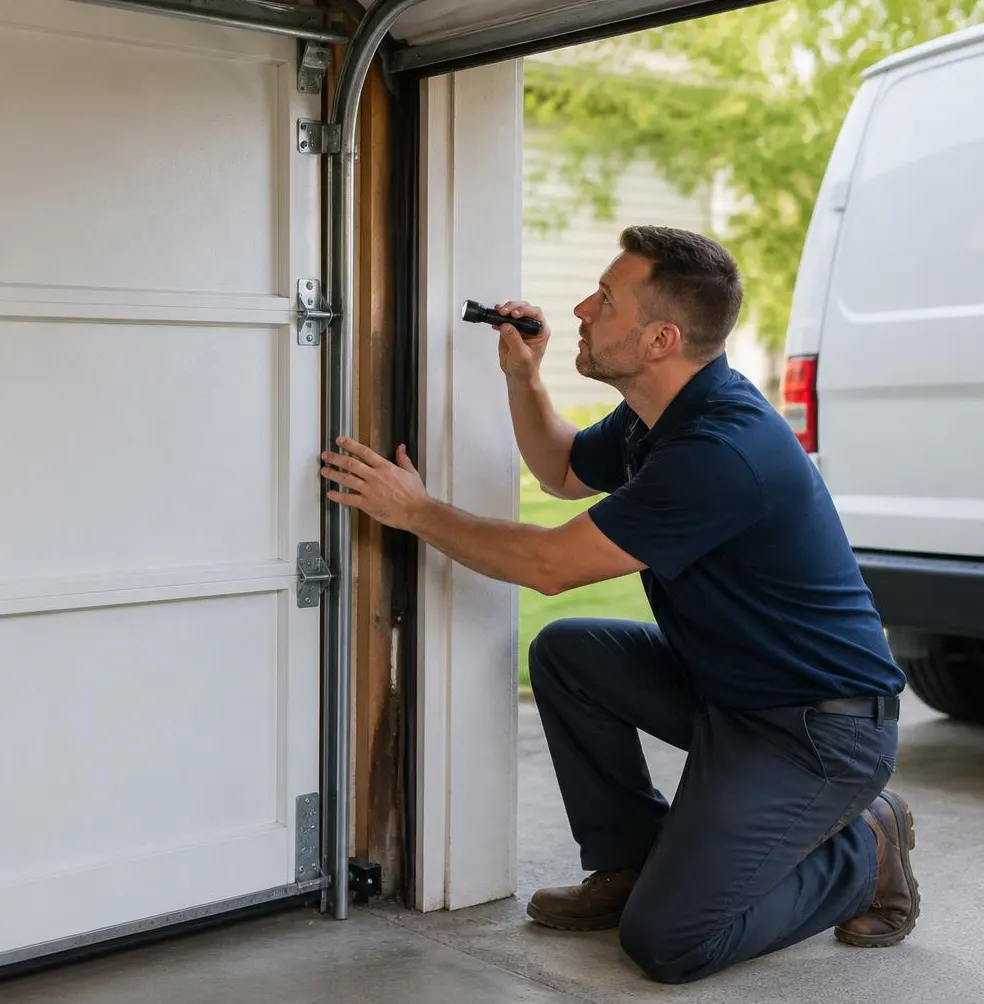
If the dent is near a hinge, roller, or track; if the door scrapes, binds, or doesn't sit flush; if there's more than one dent on a panel; or if the damage happened during a storm, it's worth having it looked at rather than guessing. We'll inspect the panel, check roller and track alignment, and look at the reinforcement strut if your door has one, through our Garage Door Cable & Roller Repair service. If the panel itself is compromised, we can handle a section swap or, when it makes more sense, a full Garage Door Installation & Replacement rather than a repair that won't hold.
Settle the argument for good — call Lake City Door & Opener and we'll tell you straight whether that dent is cosmetic or something more, serving Lake City, FL and the surrounding Columbia County area.